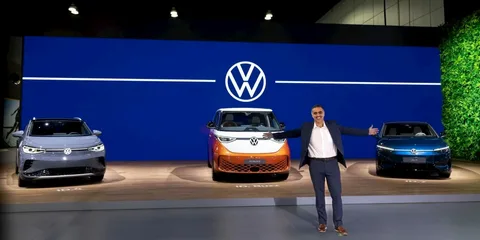
American electric vehicle manufacturer Rivian announced a landmark four billion dollar strategic partnership with Volkswagen Group on Wednesday, a deal that will see the German automaker integrate Rivian’s proprietary electrical architecture and software platform into multiple vehicle lines across the VW, Audi, and Scout brands. The agreement represents one of the largest cross-continental EV technology transactions in automotive history and signals a significant shift in how legacy manufacturers are approaching the software-defined vehicle transition.
Under the terms of the deal, Rivian will receive staged capital injections totaling four billion dollars over a four-year period in exchange for licensing its zonal electrical system — a next-generation architecture that dramatically simplifies vehicle wiring and enables over-the-air software updates in the manner familiar to smartphone users. Volkswagen engineers have reportedly been evaluating multiple technology partners for more than eighteen months before selecting Rivian as the preferred collaborator.
For Rivian, the partnership provides critical financial stability after a period of heavy investment in manufacturing scale-up that pressured its balance sheet. The company’s Normal, Illinois, assembly plant is currently operating at significantly below full capacity, and the additional revenue from licensing fees is expected to materially accelerate the path to profitability. Rivian’s share price surged more than 22 percent in after-hours trading following the announcement.
Volkswagen’s decision reflects a broader recognition among traditional automakers that developing cutting-edge EV software platforms internally from scratch is both slow and extraordinarily expensive. Partnering with a born-electric company allows VW to leapfrog several years of development time.
Analysts noted the deal may also have geopolitical dimensions, as Western automakers seek to reduce dependence on Chinese technology platforms amid growing regulatory scrutiny of cross-border data flows in connected vehicles.